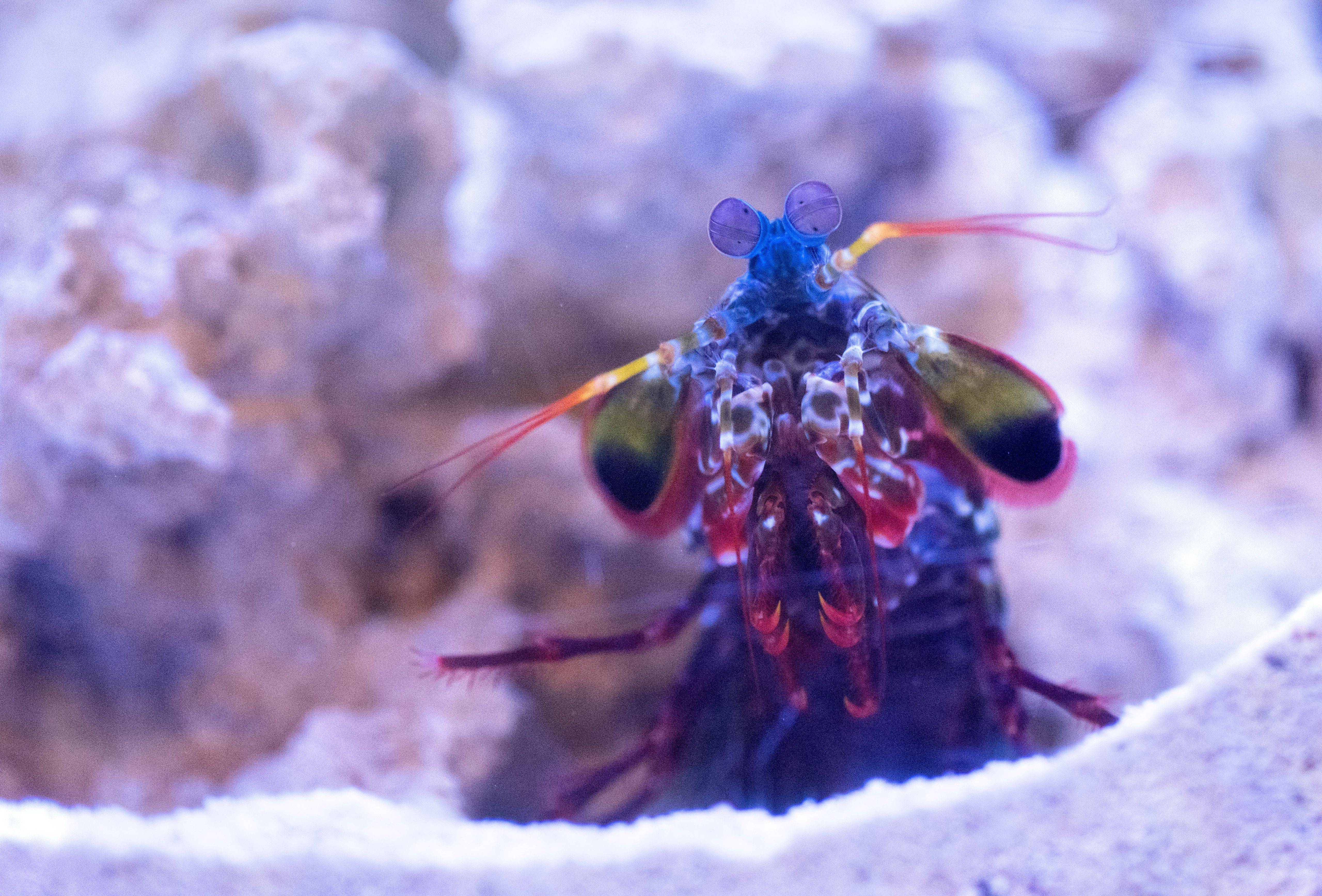
Mantis shrimp have one of the most powerful punches on the planet. That’s why David Kisailus, UC Irvine professor of materials science and engineering, has spent almost two decades studying the clubs of these small, but mighty creatures.
Kisailus’s lab is filled with extraordinary creatures like the mantis shrimp and the diabolical ironclad beetle, which can survive being run over by a car. As a materials scientist and engineer, he unlocks the secrets of these resilient creatures for the benefit of mankind.
The peacock mantis shrimp, for instance, are armed with two hammerlike appendages called dactyl clubs that can smash their prey accelerating faster than a 22-caliber bullet. “It’s the fastest smashing organism on the planet in water,” said Kisailus. “They can smash thousands of times without breaking.”
Helicoid structure revolutionizes material design
The peacock mantis shrimp’s dactyl clubs have a peculiar architecture called the helicoid, which looks like a spiral staircase that’s made of layers of fiber. “Each layer is rotated at some small angle to give you this helix structure,” said Kisailus. “It’s the combination of materials and the architecture that actually provide this robust toughness.”
Inspired by the helicoid structure, his lab made panels mimicking this structure from carbon fiber and epoxy resin. In testing their panels against those used in Boeing aircraft, they found that their bio-inspired panel suffered half the damage of the aircraft panel. The helicoid structure could thus produce the same strength and resilience in a material with just half the weight. “Half the weight means half the fuel. Half the fuel means half the CO2 emissions,” said Kisailus. “So it’s quite impactful, pun intended.”
The helicoid structure has been used to make stronger professional hockey sticks and is creating lighter aircraft, drones, armor and recently, mortar-based plates for the U.S. Army.
Nanoparticles cut impact damage in half
Kisailus has also discovered that the clubs have a uniquely designed nanoparticle coating that absorbs and dissipates energy. “Think about punching a wall a couple thousand times at those speeds and not breaking your fist,” said Kisailus.
His lab used transmission electron and atomic force microscopy to examine the nanoscale architecture and material components of the clubs’ surface layer. They found that the nanoparticles are spheres made of intertwined nanocrystals that are stacked together like Lego pieces, with small orientational differences where they join. These crystalline interfaces fracture and break during high-speed impact, absorbing energy and thus decreasing the penetration depth by half.
“At relatively low strain rates, the particles deform almost like a marshmallow and recover when the stress is released,” Kisailus said. “We can imagine ways to engineer similar particles to add enhanced protective surfaces for use in automobiles, aircraft, football helmets, and body armor.”
Among his projects funded by the U.S. Department of Defense, Kisailus’s lab also recently received a $4 million grant from the Air Force Office of Scientific Research to study how microbes and bacteria can extract rare earth elements for environmentally friendly mining that can be used both on the Earth and the moon. “We think we found a secret sauce behind it,” said Kisailus, a materials scientist who is gleaning an endless stream of insights into resilience from nature’s creatures.
- Natalie Tso